Bored Piers Melbourne: Engineered Foundations for Reactive Clay & Sloping Sites
Deep, engineered bored pier foundations for residential and commercial projects across Melbourne, built to handle reactive clay and variable soil conditions.
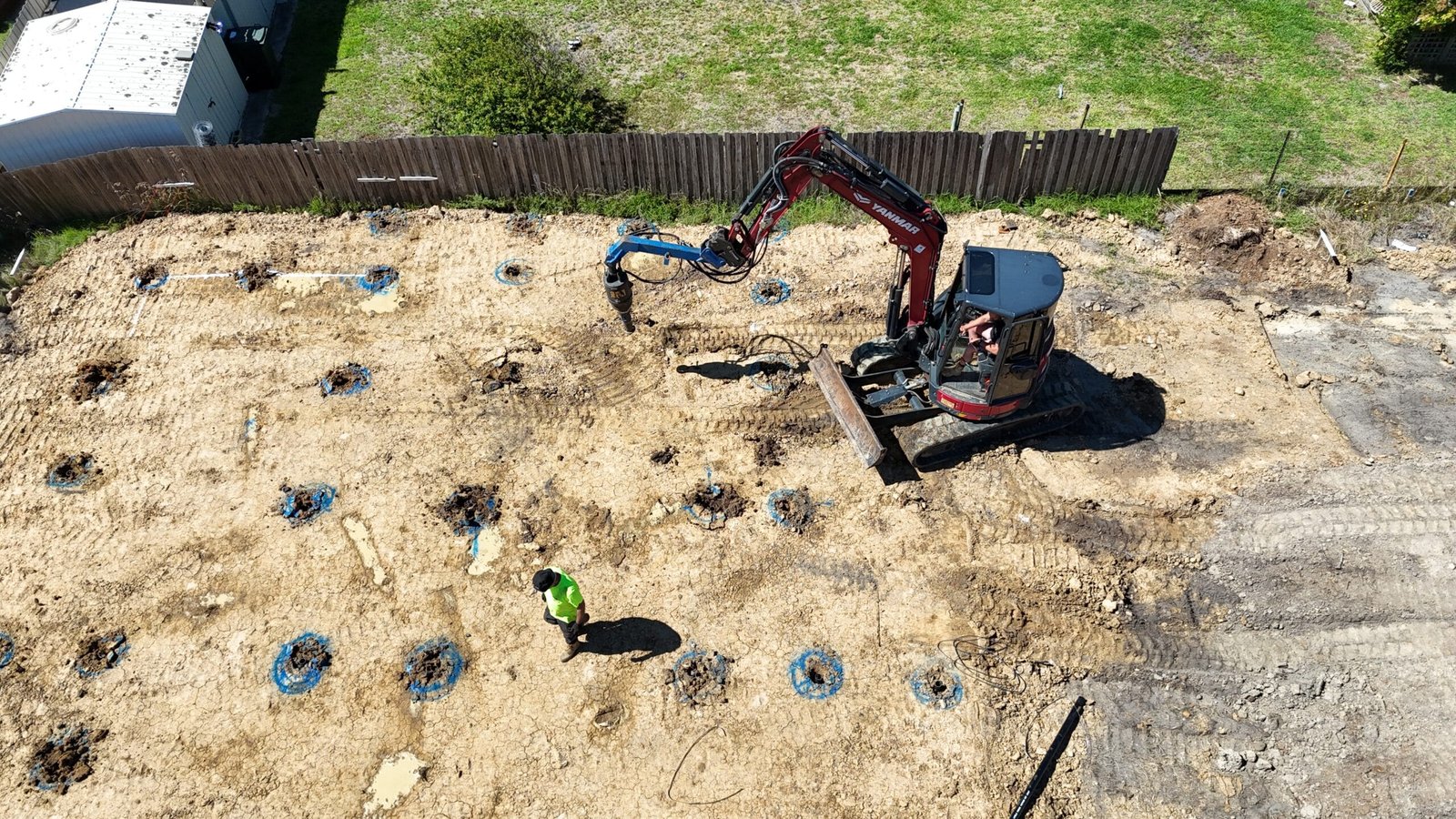
What Are Bored Piers?
Bored piers are deep, cylindrical concrete foundations formed by boring or auguring into the ground and filling the resulting shaft with reinforced concrete. As one of the more experienced bored pier contractors Melbourne builders and homeowners rely on, HPL Construction installs bored piers to carry structural loads down through unstable topsoil to a stronger, more reliable layer of soil or rock — giving your slab, retaining wall or structure a foundation that will not move.
Bored piers are one of the most common foundation solutions used across Melbourne, largely because so much of the region sits on reactive clay. Reactive clay expands when wet and contracts when dry, which can cause standard shallow footings to move over time, leading to cracking in slabs, walls and brickwork. Bored piers bypass this problem entirely by transferring the load of the structure past the reactive layer, down to stable soil or rock at depth, so the foundation stays put no matter what the clay above it is doing.
Every bored pier project starts with an understanding of what is actually happening below the surface. Pier depth and diameter are determined by your site's soil classification, the engineer's specification, and the loads the structure needs to carry — a single-storey home extension has very different requirements to a two-storey dwelling or a commercial structure. We work from the engineering drawings for your project to install piers to the exact depth, diameter and reinforcement specification required, rather than guessing at a standard depth that may not suit your site.
Foundation Options: Bored Piers, Screw Piles & Strip Footings
Bored piers are one of three foundation methods we use, depending on your site and structure.
Benefits of Bored Pier Foundations
Stable, Long-Term Foundation
Piers bear on stable soil or rock, avoiding the movement that affects shallow footings on reactive clay.
Suited to Reactive Clay
Ideal for Melbourne's widespread reactive clay soils, where shallow footings are prone to movement.
Engineered to Specification
Every pier is bored and reinforced to your engineer's exact depth, diameter and load requirements.
Reduces Cracking Risk
A properly founded structure is far less likely to develop cracking from footing movement over time.
Works on Sloping Sites
Bored piers are well suited to sloping or variable sites where uniform shallow footings aren't practical.
Supports Extensions & New Builds
Used for everything from new home foundations to extensions, decks and retaining wall footings.
Building on reactive clay or a sloping block?
Get Your Free QuoteWhere This Service Is Used
Bored piers are used wherever a structure needs a deep, reliable foundation that bypasses unstable or reactive soil near the surface. Common applications include:
- Foundations for new home builds on reactive clay sites
- Footings for retaining walls, particularly taller or engineered walls
- Foundations for home extensions and second-storey additions
- Deck and pergola footings requiring deeper support
- Commercial and multi-unit building foundations
- Foundations on sloping or variable sites where shallow footings aren't suitable
Bored piers are especially common across Melbourne's established and growth suburbs alike — from bored piers in Werribee to bored piers in Craigieburn — wherever reactive clay or variable soil conditions mean a standard shallow footing isn't enough to keep a structure stable over the long term.
Because bored piers form the structural foundation of whatever is built above them, getting the sequencing right matters. Piers are typically installed after excavation and before slab or structural work begins, based on engineering drawings that specify exact pier positions, depths and reinforcement. We coordinate closely with your engineer and builder to make sure piers are installed correctly the first time, since this stage of the build is far more difficult and costly to correct once concrete has been poured.
Residential & Commercial Applications
Residential Bored Piers
- New home foundations on reactive clay
- Home extension and second-storey footings
- Deck and pergola footings
- Retaining wall footings
- Foundations on sloping blocks
- Footings for granny flats and outbuildings
Commercial Bored Piers
- Commercial building foundations
- Multi-unit development footings
- Engineered retaining structure footings
- Larger-diameter piering for heavier loads
- Foundations on variable or reclaimed sites
- Piering for staged commercial developments
Our Process, From Enquiry to Completion
- Enquiry & site details. Tell us your address, what the piers need to support, and where you're up to. If you already have a soil report or engineering drawings specifying pier depths and diameters, send them through -- if not, we can point you to a local geotechnical provider or structural engineer.
- Free, itemised quote. We assess your site and provide a clear written quote covering site setup, boring, reinforcement, concrete supply and the pour, based on your engineer's pier schedule.
- Scheduling. Once you're ready to proceed, we lock in a start date and confirm site access and equipment requirements ahead of time, coordinating with your builder so piering happens at the right point in the wider build sequence.
- Construction. Our crew carries out the piering work -- see the construction steps below for the full breakdown, from engineering review through to the concrete pour.
- Inspection & handover. Completed piers are checked against the engineering drawings before handover, so your builder or the next trade can proceed with confidence that the foundation below is sound.
Our Bored Pier Process
A clear, engineer-led process from site assessment to a fully inspected foundation.
Engineering Review
We work from your engineer's pier layout and specification, confirming depths, diameters and reinforcement requirements.
Site Setup & Boring
Pier positions are set out and bored to the specified depth using purpose-built piering rigs suited to your site.
Reinforcement Placement
Steel reinforcement cages are lowered into each bored shaft in line with the engineering specification.
Concrete Pour
Piers are filled with concrete to the correct specification, ensuring full engagement with the bearing soil or rock.
Inspection & Sign-Off
Completed piers are inspected against the engineering drawings before the next stage of construction proceeds.
Equipment & Materials Used
HPL Construction uses purpose-built piering rigs capable of boring to the depths and diameters required across Melbourne's varied soil conditions, from standard residential piers through to larger-diameter commercial piers. Rig selection depends on site access and the specification required — a tight inner-suburban block may call for a smaller, more manoeuvrable rig, while a larger development site can accommodate heavier equipment for faster progress.
All piers are formed using engineer-specified concrete mixes and reinforcement steel, matched to the load-bearing and durability requirements of your project. Where site conditions require it, such as loose or collapsing ground, we use temporary casing to support the bore hole while it is filled, ensuring the finished pier is sound along its full length rather than compromised by ground collapse during construction.
Spoil generated during boring is managed as part of the job, either reused on-site where suitable or removed to a licensed disposal facility. We keep the piering area organised and clearly marked throughout the process, since accurate pier positioning is critical to the structure that will be built above it, and a tidy, well-managed site makes that accuracy easier to maintain from the first pier to the last.
Engineering & Compliance Considerations
Whether a site needs bored piers at all comes down to AS 2870, the standard that classifies a site's soil reactivity -- from Class A (stable sand or rock) through to Class H1/H2 (highly reactive clay) and Class E (extremely reactive). Once a soil report identifies a site as reactive, or identifies unstable or variable ground near the surface, the engineer's design may call for footings that reach a specified depth to a stronger bearing layer -- which is exactly what a bored pier is built to do.
Bored piers most commonly work alongside a slab, not instead of one. On a reactive clay site, a waffle or raft slab is typically designed to flex with minor soil movement across most of the footprint, while bored piers are added at specific points -- often around the perimeter, under load-bearing points, or beneath a retaining wall's posts -- where the engineer has determined the slab edge beam or standard footing alone isn't enough. The two systems are specified together as one engineered solution, not chosen as alternatives to each other.
Where bored piers fit against our other two foundation methods comes down to load and bearing depth, not just installation speed. Screw piles are a fast, mechanically wound steel pile suited to lighter structures -- decks, pergolas, verandahs -- where minimal excavation and quick installation matter and the loads involved are moderate. Strip footings suit a continuous wall line on reasonable, uniform ground. Bored piers are the more heavily engineered option: a poured, reinforced concrete shaft that can be taken to whatever depth and diameter the engineer specifies to reach adequate bearing capacity, which makes them the right call where soil conditions are genuinely poor, bearing strata sits deep, or the point load is beyond what a screw pile is rated for.
New residential piering typically falls under the same building permit as the wider slab, extension or structure it supports, issued by a registered building surveyor and administered under Victorian building regulations through the Victorian Building Authority (VBA). We install piers to the depth, diameter and reinforcement specification set by your project engineer, and coordinate with your building surveyor for the required inspections before the next stage of construction proceeds.
Why Choose HPL Construction for Bored Piers
Melbourne-Wide Service
Residential & Commercial
Purpose-Built Piering Rigs
Reliable Scheduling
Engineered Accuracy
Fully Insured
Experienced Team
Clear Communication
Common Challenges & How We Solve Them
Reactive clay and variable soil
We install piers to bear on stable soil or rock beneath the reactive layer, following your engineer's specification exactly.
Restricted site access
We select from a range of piering rig sizes so we can work on tighter suburban blocks without compromising on depth or accuracy.
Loose or collapsing ground
Temporary casing is used to support the bore hole in unstable ground, protecting the integrity of the finished pier.
Coordinating with builders and engineers
We work directly from engineering drawings and coordinate pier installation timing with your builder to keep the wider project on schedule.
Cost Factors
We don't publish fixed bored pier prices, because the real cost depends on site-specific variables that only become clear once we've seen your engineering specification and site. The main factors are:
- Pier depth and diameter -- set by your engineer based on soil conditions and load, and the single biggest driver of boring time and concrete volume.
- Number of piers required -- a full new-build footprint needs far more piers than a handful of footings under a retaining wall or deck.
- Soil conditions and depth to bearing strata -- deeper or harder-to-bore ground takes longer and can require different rig setups.
- Site access -- whether a standard piering rig can reach every pier position, or a smaller, more manoeuvrable rig is needed for a tight inner-suburban block.
- Ground stability -- loose or collapsing ground that requires temporary casing to support the bore hole adds time and material.
- Spoil removal -- whether excavated material can be reused on-site or needs removal to a licensed disposal facility.
Every quote we provide is itemised, so you know exactly what you're paying for. For a fast planning figure before you request a formal quote, try our Bored Pier Calculator or Excavation Calculator.
Get a fixed-price bored pier quote for your Melbourne project.
Request A QuoteSafety & Quality Standards
Piering work involves deep excavation and heavy equipment, so it is carried out under strict safety procedures at every stage. Before boring begins, we confirm service locates to avoid underground services, and our crews follow safe work method statements covering equipment operation, excavation safety and site management around open bore holes.
Every pier is installed to the depth, diameter and reinforcement specification set by your project engineer, and completed piers are checked against those drawings before construction continues. Our team is fully licensed and insured, and we follow relevant Australian Standards for piering and foundation work, so the foundation beneath your project is something you can rely on for the life of the structure.
Frequently Asked Questions
Why are bored piers used instead of standard footings?
Bored piers are used when soil conditions, such as reactive clay, mean a standard shallow footing would be at risk of movement over time. Piers transfer the load down to stable soil or rock, avoiding this risk.
How deep are bored piers?
Pier depth depends on soil conditions and your engineer's specification, but residential piers commonly range from 1.5m to 4m or more, with some commercial applications going deeper.
Do I need an engineer for bored piers?
Yes. Bored pier depth, diameter and reinforcement are specified by a structural engineer based on your site's soil report and the loads the structure needs to carry.
How long does bored pier installation take?
Most residential piering jobs are completed within 1-2 days depending on the number of piers, depth required and site access.
Can bored piers be installed on a sloping block?
Yes. Bored piers are well suited to sloping and variable sites, since each pier can be installed to a different depth as required by the engineering design.
What is the difference between bored piers and screw piles?
Bored piers are concrete foundations formed by boring and filling a shaft with reinforced concrete, while screw piles are pre-fabricated steel piles wound into the ground. Both transfer load to stable soil, but suit different site and structural requirements.
Do you install piers for retaining walls?
Yes. Engineered retaining walls, particularly taller walls, commonly require bored pier footings to provide adequate structural support.
What happens if the ground collapses during boring?
In loose or unstable ground, we use temporary casing to support the bore hole, ensuring the finished pier is sound along its full depth.
Do you provide bored piers for commercial projects?
Yes. We install bored piers for commercial and multi-unit developments in addition to residential projects, using rigs suited to larger-diameter piers.
What areas do you install bored piers in?
We provide bored pier installation throughout Melbourne and surrounding growth corridors, including the western, northern, eastern and south-eastern suburbs.
Do you provide free bored pier quotes?
Yes. We provide free, no-obligation quotes based on your engineering specification and site conditions.
Can I get an early cost estimate for bored piers before requesting a quote?
Yes. Our free online estimate tools can give you an early indication of cost before you request a formal quote.
Do you coordinate with my builder or engineer directly?
Yes. We regularly work directly from engineering drawings and liaise with builders to make sure piering is completed at the right point in the construction schedule.
What permits are needed for bored piers?
Piering for a new build or extension is typically covered under your building permit. We can advise on any additional requirements during your quote.
Can bored piers be installed close to a boundary or existing structure?
In many cases yes, though we assess site conditions carefully and take appropriate precautions to protect neighbouring structures on boundary or tight-access sites.
What's the difference between bored piers and strip footings?
A bored pier is an individual, deep, cylindrical concrete shaft that carries a point load down to stable soil or rock. A strip footing is a continuous reinforced concrete footing that runs along a wall line, suited to reasonable, uniform ground rather than deep or reactive conditions. We use whichever method -- or combination -- your site and engineering design call for.
What determines whether my site needs bored piers?
Your site's soil report and classification under AS 2870 determine this. Sites classed as reactive clay (Class H1/H2) or extremely reactive (Class E), or with unstable or variable ground near the surface, often need footings taken to a specified depth to reach adequate bearing capacity -- which is what a bored pier provides.
Do bored piers replace my slab, or work alongside it?
Bored piers typically work alongside a slab, not instead of one. On a reactive site, a waffle or raft slab is usually designed to flex with minor soil movement, while bored piers are added at specific points -- such as the perimeter, load-bearing points or under a retaining wall's posts -- where the engineer has determined additional depth is required. The two are specified together as one engineered solution.
What affects the cost of bored pier installation?
Pier depth and diameter, the number of piers required, soil conditions and depth to bearing strata, site access for our piering rigs, whether the ground requires temporary casing, and spoil removal all factor into cost. We provide a free, itemised quote once we've reviewed your engineering specification and site.
What happens between my initial enquiry and the piers being installed?
We start with your site details and any engineering drawings or soil report you have, provide a free itemised quote, then lock in scheduling and access requirements with your builder. Our crew carries out the piering from engineering review through to the concrete pour, and completed piers are checked against the approved design before handover.
Related Services & Resources
Bored Piers Across Melbourne
We install bored pier foundations throughout Melbourne and Victoria, wherever reactive clay, variable soil or sloping ground calls for deep, engineered footings. Browse your region below, or see every suburb we service.
Related Calculators
Get an instant planning figure before you request a formal quote.
Ready to Secure Your Foundation?
Request your free, no-obligation bored pier quote today and build on a foundation engineered to last.