Concrete Driveways Melbourne: Built to Last, Designed to Impress
Durable plain, coloured and exposed aggregate concrete driveways for homes and businesses across Melbourne, built with proper drainage and long-term strength in mind.
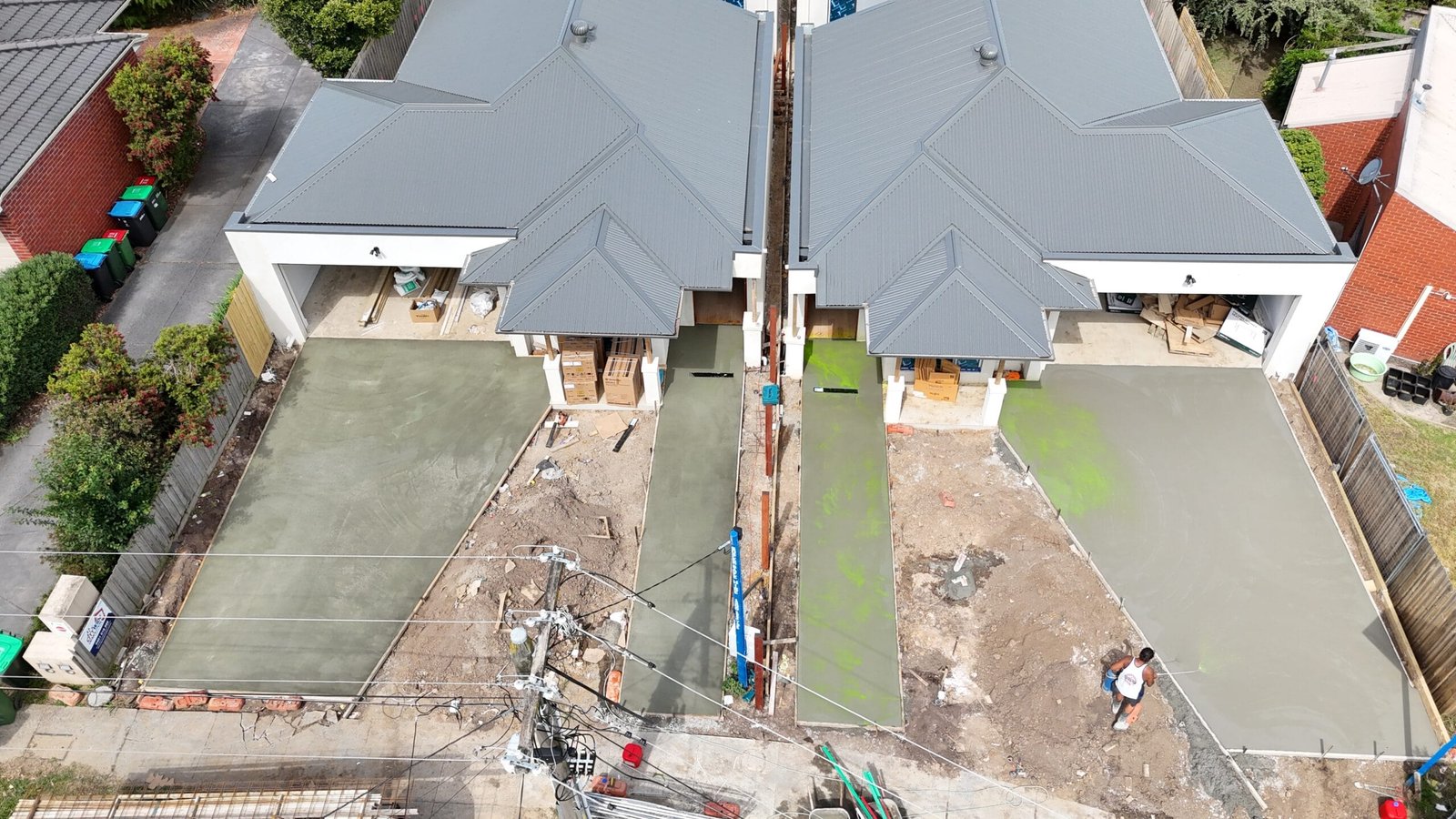
What Is a Concrete Driveway?
A concrete driveway is a durable, engineered surface connecting your garage or carport to the street, designed to handle regular vehicle loads while adding to the street appeal of your home. As experienced concrete driveway contractors, HPL Construction designs and pours plain, coloured and exposed aggregate driveways across Melbourne, built to the correct thickness, reinforcement and fall for long-term durability and proper drainage.
Concrete remains one of the most popular driveway materials because of its combination of strength, low maintenance and design flexibility. A plain concrete driveway offers a clean, cost-effective finish, coloured concrete allows the driveway to complement your home's exterior, and exposed aggregate delivers a textured, decorative surface with genuine street appeal. Each option is poured using the same underlying process — correct base preparation, reinforcement and finishing — with the finish coat being what sets the final look apart.
A well-built driveway starts well below the visible surface. Proper base preparation, adequate reinforcement, and control joints placed at the correct spacing are what determine whether a driveway lasts for decades or starts cracking within a few years. We treat this groundwork as seriously as the finish itself, since a driveway that looks great on day one but hasn't been built to specification underneath is a false economy for any homeowner.
Drainage and fall are just as critical as strength. A driveway needs enough fall to shed water away from your home's foundation and toward appropriate drainage points, without being so steep that it becomes impractical to use. We assess your site's levels carefully before pouring, so your finished driveway looks good and functions properly for the life of the surface.
Types of Concrete Driveways We Build
From finish to function, here's how our driveway options compare.
Benefits of a Concrete Driveway
Built to Handle Vehicle Loads
Reinforced to the correct thickness and specification for regular car and light vehicle traffic.
Low Maintenance
Concrete driveways require minimal upkeep compared to gravel, asphalt or paved alternatives.
Design Flexibility
Plain, coloured and exposed aggregate finishes let you match your driveway to your home's style.
Proper Drainage & Fall
Correctly graded to shed water away from your home and prevent pooling.
Long Service Life
A well-built concrete driveway can last decades with minimal maintenance when installed correctly.
Adds Street Appeal
A quality driveway finish is one of the most visible parts of your home's exterior presentation.
Ready to upgrade your driveway?
Get Your Free QuoteWhere This Service Is Used
Concrete driveways are one of the most common residential and commercial paving applications across Melbourne. Common applications include:
- New home driveway construction
- Driveway replacement for cracked or deteriorating surfaces
- Crossovers connecting your driveway to the street
- Commercial and multi-unit development access-ways
- Car park surfacing for small commercial sites
- Shared driveways and side-access paths
Concrete driveways are poured right across Melbourne, from established inner suburbs to newer growth areas — including concrete driveways in Point Cook and concrete driveways in Berwick — where new home builds and driveway replacements are equally common.
Timing matters for driveway work as much as any other stage of a build or renovation. New driveways are typically poured toward the end of a build, once heavy machinery access is no longer required, while replacement driveways need to be sequenced around demolition of the old surface and any required base preparation. We work with homeowners and builders to schedule driveway pours at the right point in the project.
Residential & Commercial Applications
Residential Driveways
- New home driveway construction
- Driveway replacement and resurfacing
- Crossovers and street connections
- Side-access paths and secondary driveways
- Shared driveways for dual-occupancy sites
- Exposed aggregate feature driveways
Commercial Driveways
- Commercial access-way construction
- Multi-unit development driveways
- Small commercial car park surfacing
- Loading area and access-way pours
- Staged driveway construction for developments
- Durable high-traffic access surfaces
Our Process, From Enquiry to Completion
- Enquiry & site details. Tell us your address, approximate driveway area, and whether it's a new driveway, a full replacement, or includes a new crossover connection to the street. Photos of the site help us scope the job accurately from the outset.
- Free, itemised quote. We assess your site -- access, existing surface condition, fall and your preferred finish -- and provide a clear written quote covering demolition of any existing driveway, base preparation, reinforcement, concrete supply and the pour.
- Scheduling. Once you're ready to proceed, we lock in a pour date and confirm site access, concrete delivery and any council crossover permit requirements ahead of time.
- Construction. Our crew carries out the driveway build -- see the construction steps below for the full breakdown.
- Handover. Once cured, the finished driveway is handed over ready for use, with simple guidance on caring for it during the first few weeks while it reaches full strength.
Our Concrete Driveway Process
A clear, structured process from design through to a fully cured, ready-to-use driveway.
Site Assessment & Design
We assess your site's levels, drainage and finish preferences to design a driveway suited to your home.
Excavation & Base Preparation
The site is excavated and a compacted road base is prepared to the correct depth and fall.
Formwork & Reinforcement
Formwork is set to your chosen layout and steel reinforcement or mesh is placed to specification.
The Pour & Finish
Concrete is poured, compacted and finished to your chosen style — plain, coloured or exposed aggregate.
Curing & Sealing
The driveway is cured correctly and sealed where applicable, ready for vehicle use.
Equipment & Materials Used
HPL Construction uses quality road base, reinforcement mesh and engineer-specified concrete mixes suited to residential and commercial driveway loads. Base preparation uses compaction equipment to achieve a firm, stable sub-base, which is one of the most important factors in preventing cracking and settlement over the life of the driveway.
For coloured driveways, we use oxide pigments mixed through the concrete to achieve a consistent colour throughout the slab, rather than a surface-only coating that can wear unevenly over time. Exposed aggregate finishes are achieved by exposing decorative stone within the concrete mix through surface washing and finishing techniques, giving a durable, textured result that holds its appearance well.
Control joints are cut or formed at appropriate intervals across the driveway to manage the natural shrinkage that occurs as concrete cures, directing any minor movement to these joints rather than allowing random cracking to appear elsewhere in the slab. Correct joint spacing, based on driveway width and slab thickness, is a detail that makes a real difference to how the driveway looks and performs over the years ahead.
We also take care with edge and expansion detailing where a new driveway meets an existing path, garage slab or the street, since poorly finished transitions are one of the more common causes of premature chipping and cracking at a driveway's edges. Getting these details right at the time of the pour avoids the need for costly patch repairs a few years down the track.
Engineering & Compliance Considerations
Driveways carry regular vehicle loads, so thickness and reinforcement are matched to expected use rather than treated the same as a general-purpose path. A standard residential driveway is typically built around 100mm thick with SL72 mesh reinforcement, suited to normal car loads. Driveways expected to carry heavier or more frequent traffic -- trucks, commercial vehicles, or shared access-ways serving multiple dwellings -- are generally increased to around 125-150mm with SL82 mesh or higher and a higher-strength concrete mix (commonly in the N20-N32 range), based on the loads the driveway needs to handle. For larger commercial driveways and access-ways, our approach is informed by the same structural concrete principles set out in AS 3600, scaled to pavement rather than building work.
Correct fall is just as important as thickness. Every driveway is designed to shed surface water away from the dwelling and toward an appropriate discharge point -- typically the street or an existing stormwater connection -- rather than allowing it to pool against footings, garages or entryways. On sites with limited natural fall, this needs to be planned carefully at design stage so the finished level still drains correctly.
Where a driveway connects to the road, that section is a vehicle crossover and is subject to council approval. Local councils set specifications for crossover width, thickness and the grade change at the property boundary, and works generally can't begin until a permit is issued. We can advise on and help coordinate this process as part of your project.
Correctly spaced control joints, combined with adequate reinforcement and base compaction, remain the main defence against the random cracking that affects poorly built driveways -- see Equipment & Materials above for how we approach joint layout and edge detailing.
Why Choose HPL Construction for Driveways
Melbourne-Wide Service
Residential & Commercial
Modern Equipment
Reliable Scheduling
Plain, Coloured & Exposed Aggregate
Fully Insured
Experienced Team
Clear Communication
Common Challenges & How We Solve Them
Cracking from inadequate base preparation
We compact a proper road base and place reinforcement and control joints correctly to minimise cracking risk.
Poor drainage and water pooling
Careful site assessment and correct fall ensure water sheds away from your home rather than pooling on the surface.
Uneven colour in coloured driveways
Oxide pigment is mixed through the full concrete batch for consistent colour, rather than relying on a surface coating.
Matching a new driveway to an existing surface
We can match finish style, colour and joint pattern where a driveway is being extended or partially replaced.
Cost Factors
We don't publish fixed driveway prices, because the real cost depends on variables that are specific to your site and only become clear once we've assessed it. The main factors are: driveway area and shape, whether an existing driveway needs to be removed and disposed of first, site access for trucks and concrete pumping, the amount of excavation and base preparation required, ground conditions and slope, the finish you choose (plain, coloured or exposed aggregate), and whether a new or altered crossover forms part of the job. Every quote we provide is itemised, so you know exactly what you're paying for before work begins.
For a fast planning figure before you request a formal quote, try our Concrete Driveway Calculator.
Get a fixed-price driveway quote for your Melbourne property.
Request A QuoteSafety & Quality Standards
Driveway construction involves excavation, heavy formwork and concrete placement, often close to existing structures, fences and services, so it is carried out under careful site safety procedures at every stage. Our crews confirm service locates before excavation begins and manage site access to protect both workers and the public during the pour.
Every driveway is built to the correct thickness, reinforcement and fall for its intended use, in line with relevant Australian Standards. Our team is fully licensed and insured, and we check base preparation, reinforcement placement and finishing at each stage, so your finished driveway is both good-looking and genuinely built to last.
Frequently Asked Questions
How thick should a concrete driveway be?
Residential driveways are typically 100mm thick, though this can vary based on soil conditions, vehicle loads and your engineer's specification.
What is the difference between plain, coloured and exposed aggregate driveways?
Plain concrete offers a clean, cost-effective finish; coloured concrete uses oxide pigment for a custom colour; exposed aggregate exposes decorative stone within the mix for a textured, premium look.
How long does a concrete driveway take to cure before use?
Concrete typically reaches enough strength for light vehicle use within about 7 days, with full strength reached around 28 days, though this can vary by mix and weather.
Why do concrete driveways crack?
Cracking is most commonly caused by inadequate base preparation, insufficient reinforcement, or incorrect control joint spacing, all of which correct construction is designed to prevent.
Can you replace an existing cracked driveway?
Yes. We remove and dispose of the old driveway, prepare a proper base, and pour a new driveway to current standards.
Do you install crossovers as well as driveways?
Yes. We install council-compliant crossovers connecting your driveway to the street as part of a full driveway project.
How much does a concrete driveway cost in Melbourne?
Cost depends on driveway size, finish type and site preparation required. We provide a free, itemised quote based on your specific project.
Do concrete driveways need sealing?
Sealing isn't always required but can improve stain resistance and enhance the finish, particularly for coloured and exposed aggregate driveways.
Can a concrete driveway be poured on a sloping block?
Yes. We assess your site's levels and design the driveway with appropriate fall and, where needed, step transitions for sloping sites.
Do you provide driveways for commercial properties?
Yes. We construct driveways and access-ways for commercial and multi-unit developments in addition to residential projects.
What areas do you pour driveways in?
We pour concrete driveways throughout Melbourne and surrounding growth corridors, including the western, northern, eastern and south-eastern suburbs.
Do you provide free driveway quotes?
Yes. We provide free, no-obligation quotes for all driveway projects, based on your site conditions and finish preferences.
Can I get an early cost estimate for my driveway before requesting a quote?
Yes. Our free online estimate tools can give you an early indication of cost before you request a formal quote.
Do I need council approval for a new driveway or crossover?
Crossovers typically require council approval, which we can advise on and help coordinate as part of your project.
How do I maintain a new concrete driveway?
Concrete driveways require minimal maintenance — occasional cleaning and resealing where applicable is generally enough to keep them looking their best for years.
Who arranges the council permit for a new or altered crossover -- me or HPL Construction?
We can advise on and help coordinate the council crossover permit application as part of your project. The permit itself is issued by your local council under their vehicle crossing requirements, but our team manages the practical side of the process alongside your driveway build.
How thick and heavily reinforced does a driveway need to be for trucks or multiple vehicles?
Standard residential driveways are generally 100mm thick with SL72 mesh reinforcement, suited to normal car loads. Driveways expected to carry heavier or more frequent vehicle traffic -- trucks, commercial vehicles or shared multi-dwelling access-ways -- are typically increased to around 125-150mm with SL82 mesh or higher, and may use a higher-strength concrete mix, based on the expected loading.
How is fall and drainage designed into a new driveway?
Every driveway is designed with a fall that directs surface water away from your home and toward an appropriate discharge point, such as the street or an existing stormwater connection, avoiding pooling against footings or garage entries. On sites with limited fall, we plan the levels carefully at the design stage so water sheds correctly once the pour is complete.
What concrete grade do you use for driveways, and is it based on any engineering standard?
We use concrete grades appropriate to the application, typically in the N20-N32 range depending on expected loads and site conditions, paired with SL72 or SL82 mesh reinforcement. For larger commercial driveways and access-ways, our approach is informed by the same structural concrete principles set out in AS 3600, adapted to the scale of a pavement rather than a building structure.
Related Services & Resources
Concrete Driveways Across Melbourne
We build concrete driveways throughout Melbourne and Victoria, from established inner suburbs to new estates on the urban fringe. Browse your region below, or see every suburb we service.
Related Calculators
Get an instant planning figure before you request a formal quote.
Ready to Transform Your Driveway?
Request your free, no-obligation driveway quote today and give your property a driveway built to last.